Case Study Details

Document Parsing Tool

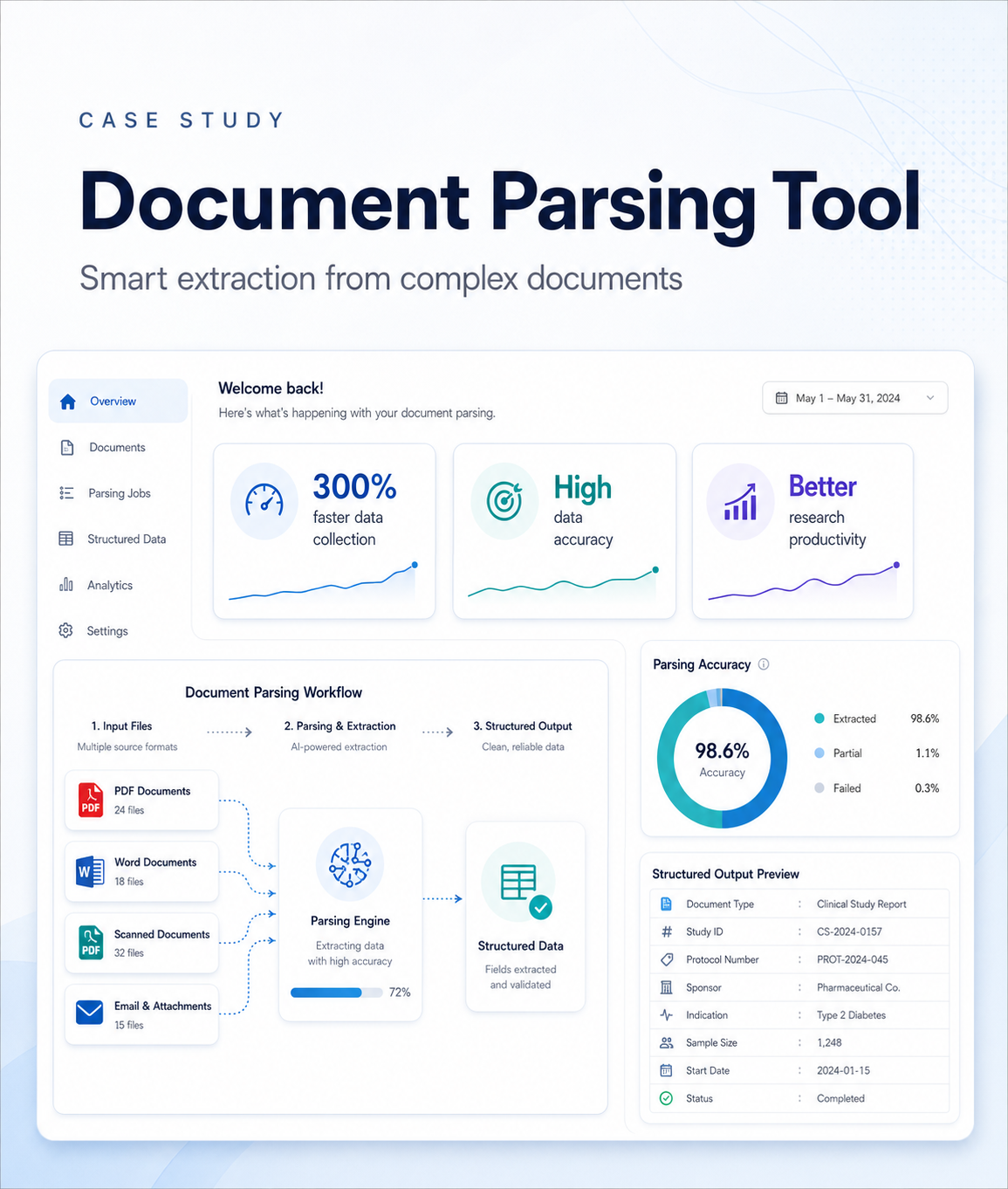
A customized document parsing solution developed for IQVIA to extract structured information from highly variable document formats using advanced NLP, template-based extraction, and scalable processing workflows.

Retail, eCommerce Web Development Document Parser
300% faster data collection High data accuracy Better research productivity
IQVIA Document Parsing Tool

Project overview

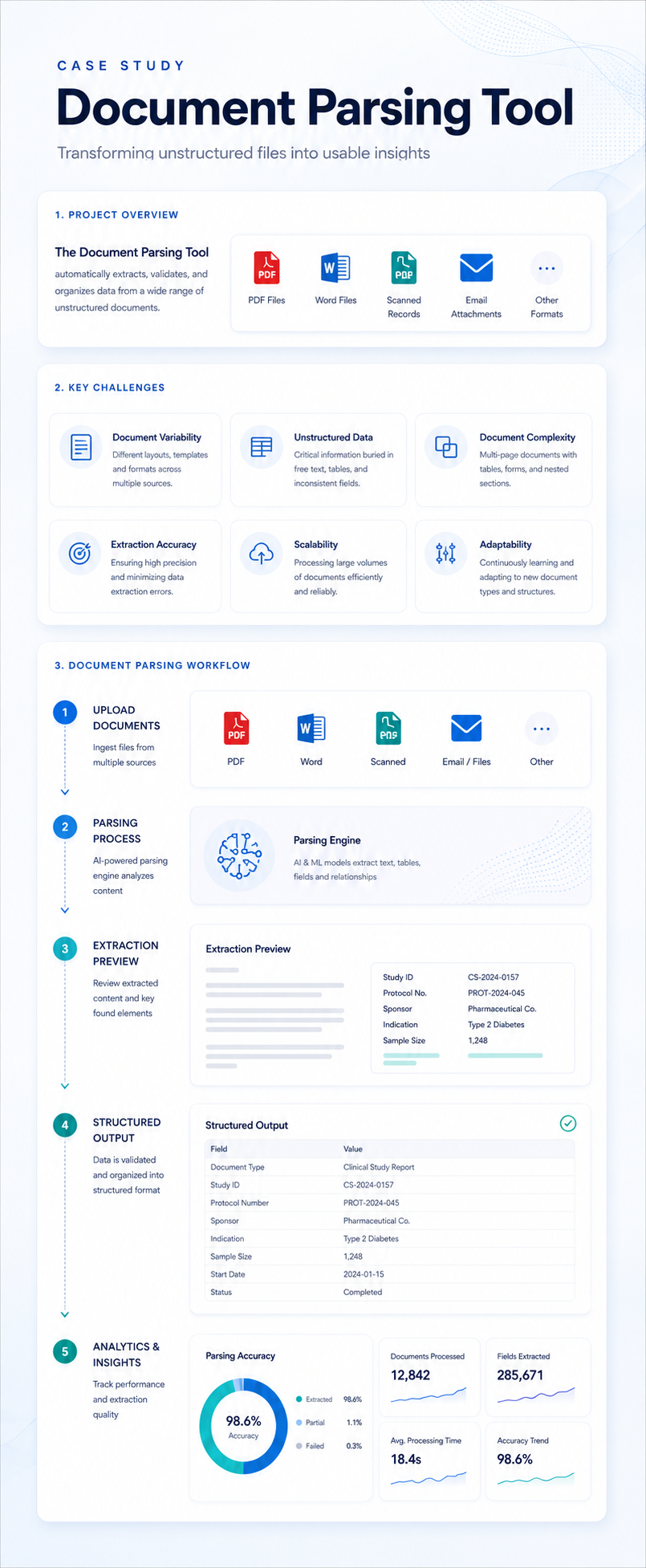
IQVIA required a flexible document parser capable of reading PDFs, Word files, scanned records, and other formats to extract meaningful information for analysis, reporting, research workflows, and system integration.

Complex format handling

Support document layouts ranging from simple text files to tables, charts, and nested structures.

Accurate extraction

Reduce errors in data capture and improve reliability for research and business decisions.

Scalable processing

Process large document volumes efficiently while adapting to changing document patterns.

Challenge

Creating a document parser involved managing format diversity, unstructured content, data accuracy, performance, and long-term adaptability across evolving document types.

Document variability

Documents came in multiple formats such as PDFs, Word files, scanned images, and emails, each with different layouts and structures.

Unstructured data

Free-form text, tables, images, and graphs made it difficult to identify and extract relevant data consistently.

Document complexity

Some files included nested data, structured reports, tables, and charts, requiring deeper parsing logic and pattern analysis.

Data extraction accuracy

Reliable extraction was critical because incorrect output could affect downstream analysis, workflows, and decision-making.

Scalability and performance

The parser had to process large document volumes quickly while maintaining strong performance and consistent output quality.

Adaptability and robustness

Formats evolve over time, so the parser needed strong error handling and the ability to adapt to layout and content changes.

Our Solution

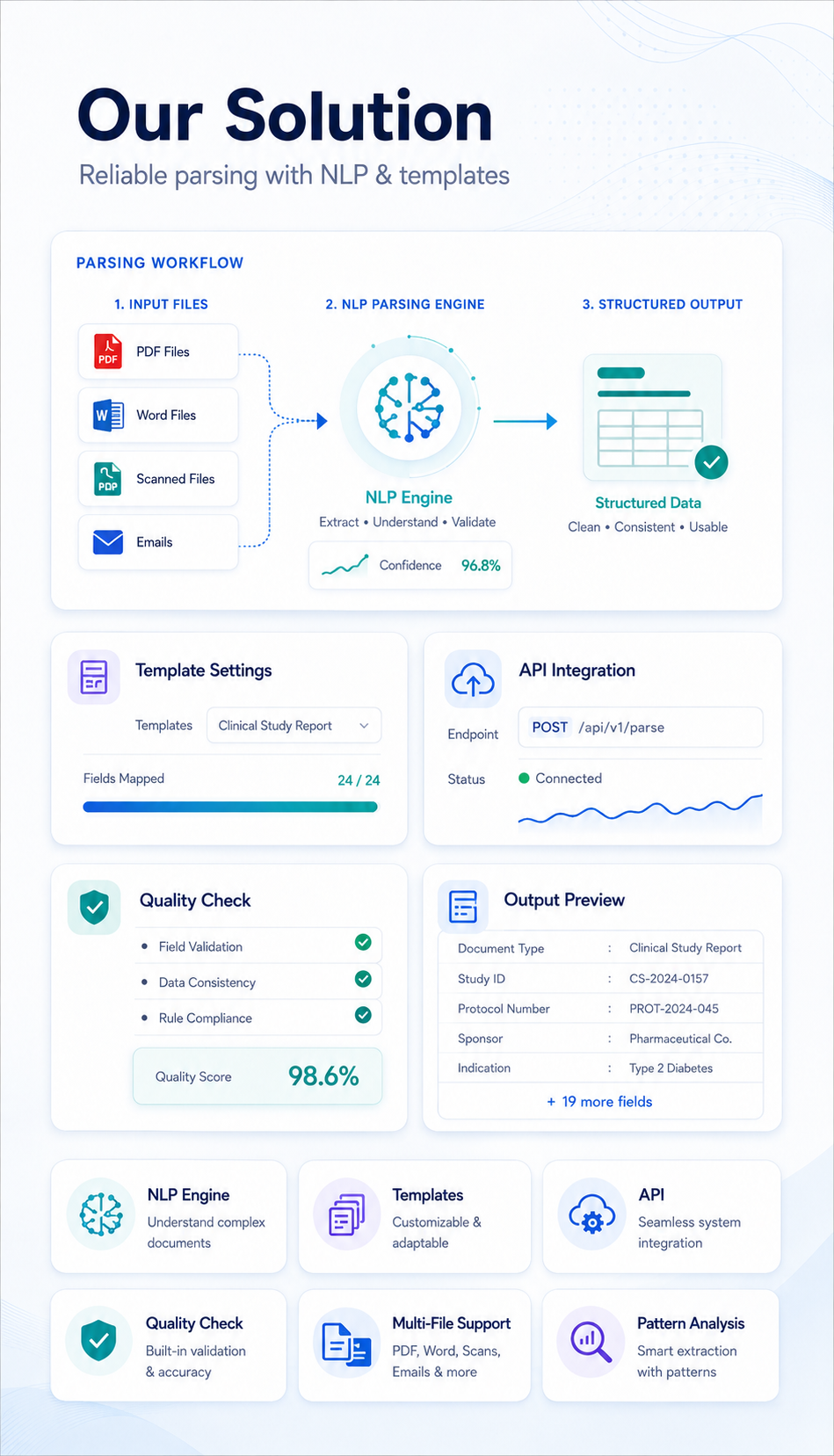
We proposed and developed a customized parser tool tailored to the client’s workflows, document patterns, and integration needs, backed by NLP and quality checks.

NLP capabilities

Advanced NLP algorithms were used to extract relevant information from scientific literature, patents, and regulatory documents.

Customizable templates

Template-based extraction allowed teams to define exact data points and extraction rules based on research objectives.

System integration

The tool was prepared for integration with existing databases and data management systems through API-based connectivity.

Quality assurance mechanisms

Validation checks and robust error handling ensured more reliable extraction and reduced inconsistencies in output data.

Multi-file-type support

The parser was designed to read PDFs, Word files, and other common formats so it could populate systems, reports, and business records.

Pattern analysis approach

Initial documents were analyzed for recurring and non-recurring patterns, then a custom parser returned the contents in structured text format.

The Departments Benefitted

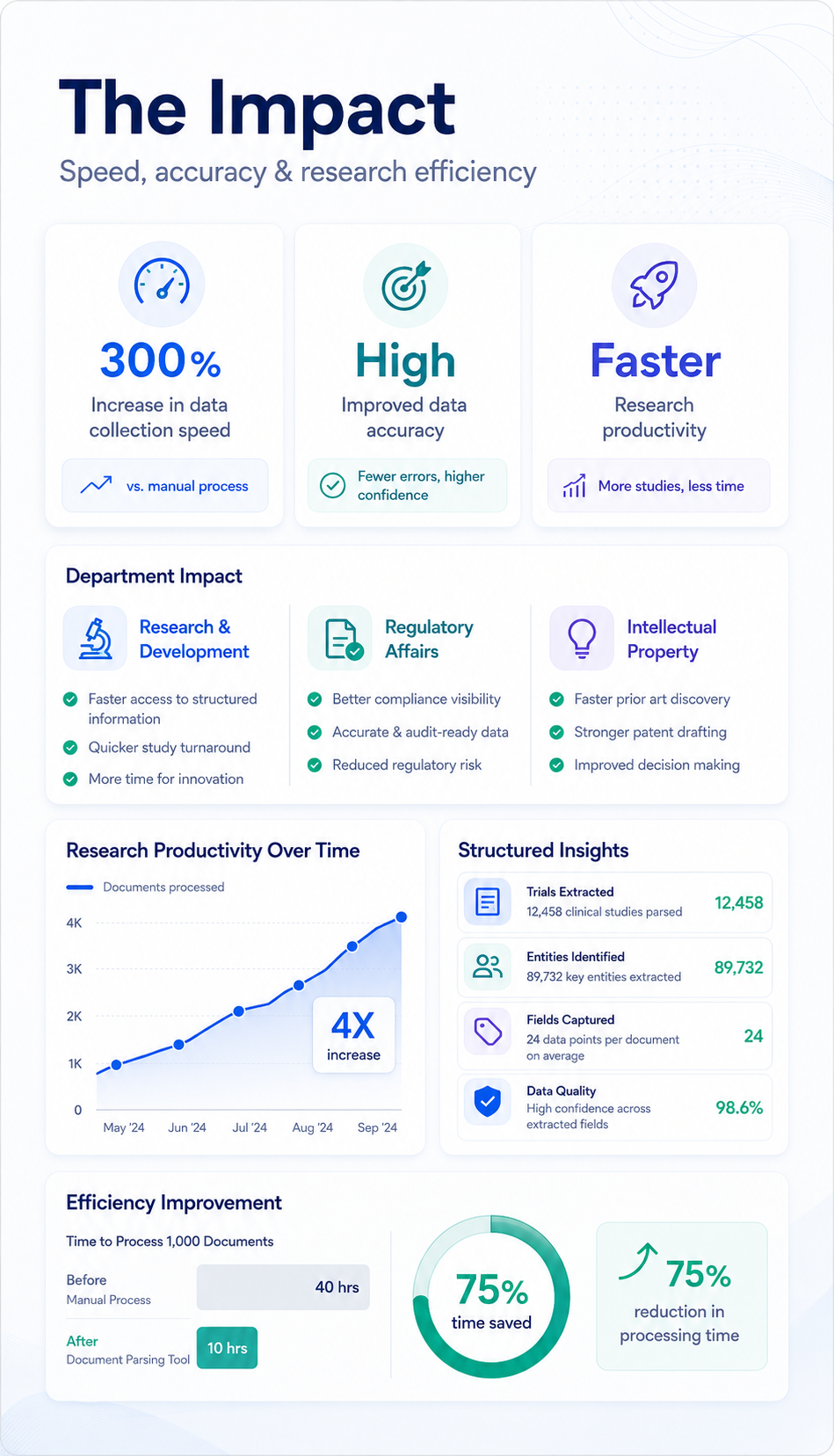
The solution supported research, compliance, and intellectual property teams by improving access to extracted insights and reducing manual document review effort.

Research and Development

Faster extraction of data from literature and patents accelerated discovery and analysis work.

Regulatory Affairs

Improved analysis of compliance documents and support for regulatory review processes.

Intellectual Property

Better extraction of patent insights supported filings, research review, and knowledge organization.

The Impact

The parser delivered major efficiency gains, stronger extraction accuracy, and faster access to insights for research and decision-making teams.

300%

Increase in data collection speed

Processing became significantly faster, reducing time and resource demands.

High

Improved data accuracy

Advanced NLP and quality checks reduced errors in extracted data.

Faster

Research productivity

Researchers gained quicker access to structured insights for better decisions.

Result: The document parser tool improved speed, data quality, and research efficiency by transforming unstructured content into usable information.

Key discovery and implementation steps

Before finalizing the solution, we evaluated tools, interviewed stakeholders, and studied source data deeply to identify the best parsing strategy.

Technology Assessment

Existing parsing technologies were reviewed, and an MVP was prepared using two highly complex document formats including tabular data.

Stakeholder Interviews

Discussions with research, regulatory affairs, intellectual property, and data collection teams revealed pain points and expected outcomes.

Data Analysis

Detailed study of source documents showed that much of the important input data was tabular and came from multiple vendors and ERP systems.

Conclusion

The customized document parser successfully addressed document variability, unstructured content challenges, and scalability needs through a dynamic, reliable, and adaptable solution.

By combining advanced NLP, customizable extraction templates, quality assurance, and integration readiness, the system improved data reliability, sped up workflows, and delivered more usable information across research and regulatory processes.

This updated version now places the old IQVIA content into your new design format while keeping the page responsive, clean, and suitable for dynamic content changes.

  • Old content placed in the new case study design
  • CloudFront URLs replaced with Azure Edge base URL
  • Same premium `csd-*` structure maintained
  • Proper responsive dynamic-content-friendly layout

Need a custom document intelligence solution?

Let’s build your next smart workflow platform

This page is now properly updated into the new design and can support dynamic case study content without breaking the layout.